Project

Over 1,000 affected households empowered amid future railway construction

With the support of STVC MCRP, this participant or project-affected person successfully acquired a brand-new sewing machine for his livelihood.

With the support of STVC MCRP, this participant or project-affected person successfully acquired a brand-new sewing machine for his livelihood.

A project in the Philippines gives hope to families and individuals who will be relocated to make way for a railway system designed to improve transportation efficiency and boost the country’s economic growth.

January 12, 2026
  • SDG: #1, #2, #3, #4, #5, #8, #10, #16, #17
  • SECTORS: Development Consulting
  • COUNTRIES: Philippines
  • DONOR: The Government of Japan through the Japan Fund for Prosperous and Resilient Asia
  • CLIENT: Asian Development Bank
  • CONTRACT VALUE: EUR 1,660,449.84 (USD 1,930,396.48)
  • DURATION: November 2020 - October 2023 (35 months)


When Alma Lucero, a senior citizen, learned that she had to leave the home she had lived in for nearly 60 years, she felt deeply upset and worried. The proposed relocation was prompted by the construction of a railway in her area, which meant leaving behind the close community ties she had developed over decades.

Alma also feared that the government-subsidised housing she and her family would move to might not be big enough for all her family members. The social disruption and uncertainty that come with resettlement are key concerns that often affect women during displacement. 

But what had helped, she said, was the support she received from a programme designed to reduce the impact of relocation — the Strengthening the Transition of Vulnerable Communities Affected by the Malolos-Clark Railway Project (STVC-MCRP).

“When the STVC-MCRP team arrived, we were given access to information, and they were able to give us updates on what would happen to us,” Alma said. “They also listened to our concerns and brought them to the proper authorities. These efforts were very useful in easing our anxiety and reducing the impacts of being displaced.”

A Mentor Interviewing A STVC Project Affected Household At Their Store That Doubles As Their Home
A mentor interviewing a project-affected household at their store that doubles as their home.

Throughout the STVC-MCRP implementation, which is spearheaded by the Philippines’ Department of Transportation’s (DOTr), Alma noted feeling a sense of relief. She received livelihood and financial literacy training and gained entrepreneurial know-how to cushion the transition to a new community, a move that is necessary to make way for the Malolos-Clark Railway that will pass through her old home in San Fernando City, Pampanga.

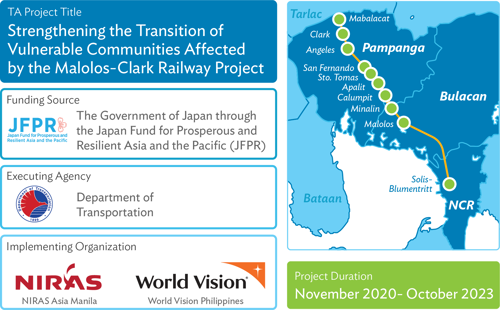
Administered by the Asian Development Bank and funded by the Japan Fund for Prosperous and Resilient Asia and the Pacific, the STVC-MCRP capacitated and supported 1,195 households from nine municipalities and cities that the future railway will traverse: Malolos and Calumpit in Bulacan province; Apalit, Minalin, Santo Tomas, Angeles City, San Fernando City and Mabalacat City in Pampanga province; and Manila in the National Capital Region.
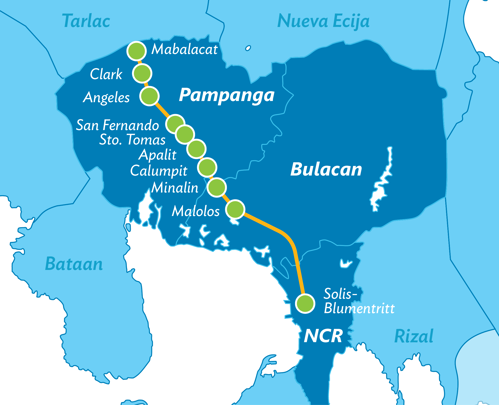


Guided by an adapted Graduation Approach (GA) in urban resettlement, the STVC MCRP’s technical assistance team made the relocation process easier for each household. Composed of NIRAS professionals, the team effectively worked with experts, partners, and trained mentors who were assigned to more than 1000 households in the affected communities. This approach ensured that coaching and mentoring are tailored to the unique needs of each participating vulnerable household.

"They also listened to our concerns and brought them to the proper authorities. These efforts were very useful in easing our anxiety and reducing the impacts of being displaced."

Alma Lucero, project participant and member of an affected household

Adapting the Graduation Approach in an urban resettlement context

Built on the premise that poverty arises from factors such as food insecurity, social stigma, and limited assets, the GA is a framework that empowers the ultra-poor to “graduate” from extreme poverty through sustainable and comprehensive means.

It addresses social and economic gaps among the ultra-poor through the lens of four pillars: social protection, livelihood empowerment, financial inclusion, and social empowerment. Traditionally, the GA involves asset transfer that would enable households to pursue income-generating activities. But given the unique context of STVC MCRP, the team modified aspects of the GA accordingly.

With these considerations in mind, the team instead focussed on capacity-building activities, and thus provided support by:

  1. Helping create plans according to households’ needs;
  2. Identifying households’ vulnerabilities and what aspects of relocation could affect them the most (e.g., job loss or asset loss, gender-related impacts of displacement);
  3. Empowering the DOTr in their efforts to physically and permanently relocate affected households.
STVC Photo 19
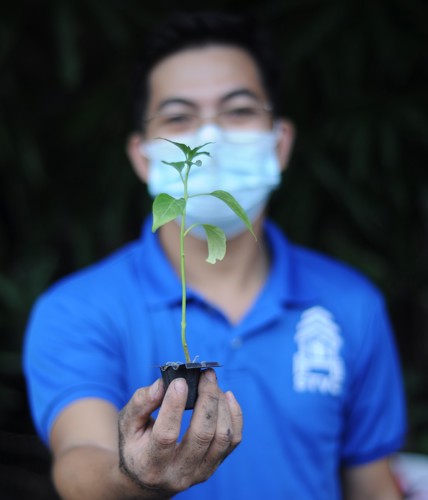
Notably, numerous women were given new livelihood opportunities.

"In the graduation process, mentors played a crucial role in guiding affected households through the various stages of resettlement."

Team Leader Maria Benilda “Chi” Redaja

The strength of STVC-MCRP lay in its network of development workers, for whom service had become a strong motivator for uplifting and mobilising affected households throughout STVC-MCRP’s two-year implementation. In total, 50 mentors were hired by the project to support the participating vulnerable households in navigating the resettlement process. These mentors were the backbone of the project and the force behind the successful implementation of STVC-MCRP.

“In the graduation process, mentors played a crucial role in guiding affected households through the various stages of resettlement,” Team Leader Maria Benilda “Chi” Redaja says. “They provided coaching support, explained the rationale behind the infrastructure development, and assisted the households in dealing with the complex resettlement issues.”

She added that while mentors did not have institutional power, they made the lives of affected households easier through their capacity- and opportunity-building efforts, successfully linking them to the appropriate agencies. This is what sets STVC-MCRP apart.

“They acted as facilitators and enabled the connection between affected households and the services provided by local government units and other stakeholders involved,” Chi shares.

Some Communities In Low Lying Areas Can Become Flooded Or Muddy During Heavy Rains, Making It Difficult For The STVC Team To Reach Them
Some communities in low-lying areas can become flooded or muddy during heavy rains, making it difficult for the team to reach them.

No household left worse off: the key achievements of STVC MCRP

Under the leadership of Chi, the STVC MCRP team set out to accomplish a total of three objectives:

  • Improved financial resilience and stability of participants;
  • Establishment of an urban resettlement baseline and monitoring system; and
  • Creation of urban resettlement knowledge products.

Improved financial resilience and stability of participants

Under the first objective, with the help of field mentors, the team rolled out capacity-building and training activities based on the four pillars of the GA, which was adapted to suit STVC MCRP’s context of involuntary urban resettlement.

The first pillar of social protection involves life skills training and linking affected households to existing basic social services provided by local government units. Under this pillar, the team saw the following outcomes:

1195 affected households

(99% of total) received access to information and assistance on resettlement from the Philippines’ Department of Transportation

1177 affected households

(98% of total) eventually observed proper water, sanitation and hygiene (WASH) practices

1012 affected households

(112% of target) were vaccinated against COVID-19, a major feat considering the project was being implemented at the height of the pandemic

As for the second and third pillars, which respectively cover livelihood improvement and financial inclusion, the team met success through different outcomes, including:

  • 246 affected households (70% of target) set up a business or improved their current business;
  • 401 affected households (160% of target) gained access to employment or were linked to employment opportunities;
  • 1,190 affected households (99% of total) understood household financial management principles learned through training, 643 of which now practise proper household budget management;
  • 135 affected households (75% of baseline) have 88 female-headed and 47 male-headed households with access to credit and other financial services from a microfinance institution, cooperative or other associations.

And for the fourth pillar, which entails promoting social empowerment or positive behaviours among project participants, the following outcomes were achieved:

  • All 1,195 affected households expressed a sustainable vision for their future grounded on positive behaviour amid their relocation;
  • All 1,195 affected households participated in GA community activities and community association activities;
  • 1,183 affected households (99% of total) participated in social empowerment activities, including those that increased the community’s capacity for collective action, households’ ability to observe and practise gender equality and responsiveness and an individual’s access to economic opportunities;
  • All 44 of the successfully relocated households during the project attended homeowners’ association activities and those of other community-based groups.


An agriculture technology graduate from Camarines Norte State College, this mentor guided affected households during a training session on urban gardening.


Establishment of an urban resettlement baseline and monitoring system

The second objective the team accomplished was more technical. It involved a tool that collected data on the project's key performance indicators and another that created a simplified evaluation of the data through dashboards, interactive reports and visuals.

The team developed these digital tools to support the monitoring and evaluation activities of STVC MCRP. Moreover, these have also been created for the Government’s use so they too can monitor and easily access data as more and more households are relocated.

Creation of urban resettlement knowledge product

To scale the learnings of STVC MCRP to larger projects, the technical assistance team also produced knowledge products tackling key lessons gathered over the more than two years of implementation. This was done to help the Philippine Government adopt best practices when enabling the rest of the households to relocate or when carrying out similar projects. Examples of documents created to achieve this end include:

  • A guide to implementing the GA in an urban resettlement context;
  • A monitoring manual;
  • 2 knowledge-sharing forums;
  • A lessons brief.

These knowledge products not only cover practical guides but also infuse these learnings with gender and social inclusion perspectives.

Project Participants On Their Way To Register Their Taxpayer Identification Number, A Major Step In Their Relocation
Project participants on their way to register their taxpayer identification number, a major step in their relocation.

All aboard for a socioeconomically empowered future

With the project having recently concluded, the team has begun implementing a second phase dubbed “Strengthening the Transition of Vulnerable Communities Affected by the South Commuter Railway” or STVC South. While STVC MCRP supported over 1000 households, STVC South is now changing the lives of over 2000 households across 10 cities with 70 mentors.

The team is more than ready for this challenge, having achieved their targets and more besides. Beyond targets, they have given new hope to families and individuals across the different provinces.

A stay-at-home mother took a course to become a trained welder — a certification she can use to support her family financially. A young woman had the opportunity to learn how to make pastries at a renowned institution. Many more acquired new skills they would have otherwise not learned without the project's support.

According to Chi, what the project did successfully, at its core, was “creating pathways for households to build up their human and, to some extent, material assets, which they can leverage to establish sustainable livelihoods.”

Through strong partnerships among different stakeholders involved in resettlement process, lives were changed. And with the lessons learned in STVC in MCRP, even more families will benefit in the future.

STVC Photo 16
Lessons learned from the programme will be used for future resettlement efforts.
Lerna Melo Magdamo

Lerna Melo Magdamo

Associate Director-IFI

Manila, Philippines

+63 918 935 1589

Maria Frahn Chezka Tabajonda

Maria Frahn Chezka Tabajonda

Project Manager

Manila, Philippines

+63 917 703 5481