Insight
Nature Inclusive Design: Looking beyond the intervention

Insight

Nature Inclusive Design (NID) has the potential to make an important contribution to offshore wind development. The challenge is making sure it's applied correctly, with a clear understanding of what we're trying to achieve. Adding habitat features to offshore infrastructure isn't, in itself, evidence of a positive ecological outcome.
Textured surfaces, habitat features incorporated into turbine foundations and stand-alone structures are all being explored as ways of supporting marine life. In the right setting they may provide ecological benefits, but those benefits depend on the site, the habitats already present and the objectives of the project.
Marine artificial structures are known to be colonised by a wide range of organisms. By introducing hard substrate, they can increase habitat complexity and affect the marine life around them. What remains much less certain is whether those changes represent an ecological improvement. An increase in biodiversity, or simply a different mix of species, doesn't necessarily mean the wider ecosystem is in a better condition.
Whether the outcome is positive depends very much on the site.
Where natural oyster or mussel reefs have been degraded, introducing additional hard habitat may support aspects of ecological recovery. However, on naturally soft sediment seabed it may create a community that wouldn't naturally occur, while also increasing opportunities for invasive non-native species or reducing the extent of existing habitat.
For me, that's where the focus needs to be. Rather than asking whether Nature Inclusive Design increases biodiversity around offshore infrastructure, I think the more useful question is whether it's the most appropriate way of achieving the ecological outcome we're looking for.
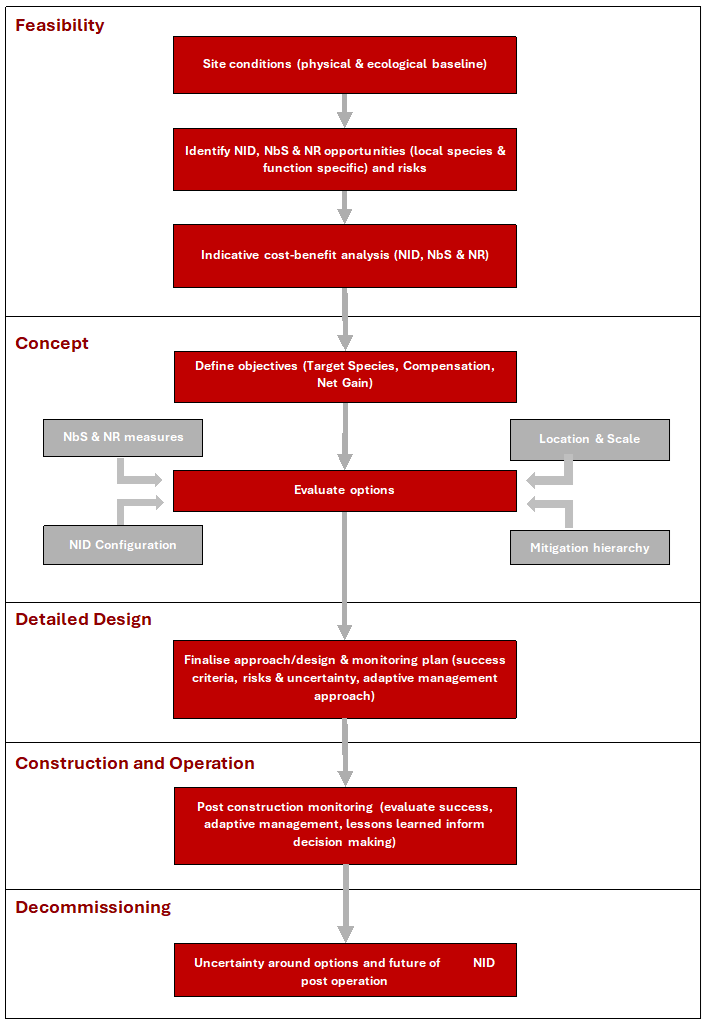
Through the WindSEED Joint Industry Project we have proposed a framework that considers Nature Inclusive Design alongside nature-based solutions, such as coastal protection or improving water quality, and nature recovery measures, including habitat restoration. The aim isn't to promote one approach over another, but to provide a structured way of assessing which option is most appropriate for a particular site and set of objectives.
Any assessment should begin with understanding the site, looking at the physical conditions, existing habitats and ecological baselines all influence what may be appropriate. From there, the likely benefits, risks and practical constraints of different approaches can be considered alongside the mitigation hierarchy of avoiding impacts first, then reducing, restoring and compensating where necessary.
Nature Inclusive Design has an important role to play, but it isn't the only option. Habitat features attached to offshore infrastructure are naturally limited by the footprint of the structure itself. Where the objective is to restore habitats or support recovery across a wider area, nature-based solutions or habitat restoration may be a better fit. For me, the priority is making sure the solution matches the objective, rather than starting with the intervention and working backwards.
There is still much we don't know about the long term ecological, social and economic value of marine artificial structures. Projects such as VALMAS are beginning to improve our understanding by developing ways to compare structures with and without intervention across ecological, social and economic measures. Monitoring during construction and operation also has an important role to play, helping build the evidence needed to inform adaptive management and future projects.
Ultimately, I don't think the challenge is deciding how to implement Nature Inclusive Design. It's deciding when it's the right intervention, when another approach may be more appropriate and making those decisions on the basis of evidence, site specific context and clearly defined objectives rather than assumption.