A female farmer has shifted from bean crops to woodlots, and a young council leader urges his peers to tend the land they will someday inherit. Although quite some distance apart and facing different circumstances, both found a common answer to help ease the weight of climate change and economic insecurity: tree planting.
After years of growing bean crops vulnerable to erratic weather, Joyce Achero — a farmer and mother in Lamwo District — turned over a new leaf by planting something more resilient. Beans are a staple in Ugandan households, but changing weather patterns can result in poor yields and financial loss, something Joyce herself has experienced.
“When you plant [these crops], it can take time,” she says. “Later on, you can fail to harvest.”
Through the World Bank-funded Investing in Forests and Protected Areas for Climate-Smart Development (IFPA-CD) Woodlots Project, Joyce gained practical skills to make the transition to tree growing and received over 1,700 quality seedlings. On land once dedicated to cultivating beans, Joyce now grows eucalyptus and black teak as a longer-term investment in her family’s future.
Eucalyptus trees grow fast and, in less than five years, Joyce can sell them to construction businesses as poles or to other enterprises as biomass. While slower to harvest, black teak is prized timber because of its durability, water resistance, and appearance.
Seedling distribution in Lamwo District, Uganda
More importantly, both species are tolerant to drought and rainfall. This fact, to Joyce, makes the investment worthwhile.
“My major vision and hope in these trees are that later when [they] grow, even if I don’t do any other farming, I’m certain that I will get money from the sales of tree products,” she says.
Joyce's story embodies a broader goal of the IFPA-CD Woodlots project: increasing tree cover beyond protected areas to enhance landscape resilience and enable communities to build more stable lives.
Inclusiveness is woven into the project’s design, reaching those most exposed to the difficulties of both displacement and climate change. Working across 19 refugee-hosting districts in western and northwestern Uganda, the project supports both refugee and host communities in landscapes facing pressure from population growth, deforestation, and climate change.
“Our target was to have women account for 10% of the beneficiaries, but we have reached 16%,” says Gladys Nagawa, NIRAS’ Gender and Safeguarding Expert. “We are also encouraging families to give women and young people access rights to land so that they can benefit from tree growing and improve the welfare of the entire household.”
5300
farmers supported through the IFPA-CD Woodlots Project
4000+
hectares of small-scale commercial woodlots established
4500000
seedlings supplied
For many women and young people in Uganda, limited access to land can make it difficult to invest in activities that generate long-term income and environmental benefits. As a result, expanding opportunities for these groups has been an important focus of the project.
The impact of this approach can be seen among participating youth, many of whom are embracing tree planting as both an environmental and economic opportunity.
Hailing from Kikuube District, Nelson Mandela Kato is a youth council leader who champions environmental issues. Uganda’s first commercial oil field is being developed in his area, and he shares that locals are worried about how this will affect air quality once extraction starts.
“This is why it is important to plant trees to secure our future,” Nelson explains. “In the long run, these trees will also be a source of income.”
Asked where the idea for tree planting had come from, he said it was thanks to Radio Hoima, a station in western Uganda. During the Farmer’s Voice Radio programme, Nelson heard about the IFPA-CD Woodlots project and immediately wanted to join. Today, he is encouraging fellow youths to follow in his footsteps.
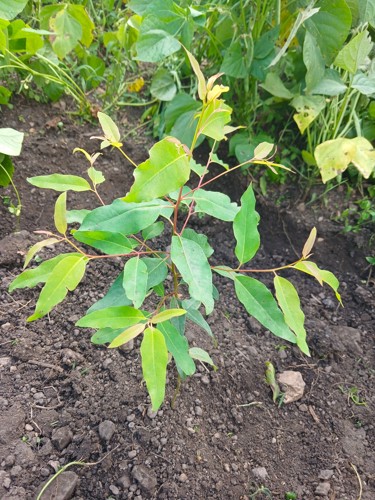
Planted seedling in Hoima District, Uganda
“Youth participation in this process is crucial,” he notes. "I will advocate for more young people to have access to land for tree planting. We are the ones who will inherit this environment, so we must be the ones to protect it.”
Joyce and Nelson are among more than 5,300 farmers supported through the IFPA-CD Woodlots Project, which supplied over 4.5 million seedlings and established over 4,000 hectares of small-scale commercial woodlots across western and north western Uganda.
IFPA-CD set out to grow more trees and planted far more than that. Beyond expanding tree coverage, the initiative instilled hope within communities, bringing a practical solution for the planet and people’s livelihoods; now everyone — especially women and young people — can invest in a worthwhile future, and one they will gladly inherit.