Project
Efficient permitting key to unlocking offshore wind’s potential in the Philippines
Project
Permits are essential to offshore wind (OSW) development, ensuring compliance with regulations, managing the environmental impact, and maximising public benefit. The Permitting and Consenting to OSW Energy in the Philippines project assessed the current permitting regime and recommended improvements to support the country’s nascent OSW market.
The Philippines has been making great strides in Offshore Wind (OSW) development, which is shaping up to be a cornerstone of the country’s plan to raise the share of renewables to 50% of its power generation mix by 2040.
With the Philippine OSW market still in its infancy, establishing a comprehensive and effective permitting system is a critical step before individual projects can take off and the country’s renewable energy potential can be fully realised. At the foundation of these efforts are key policy directives, such as Executive Order (EO) 21 that aims to foster a conducive environment for OSW in the country. The EO tasked the Department of Energy (DOE) with formulating and issuing the necessary framework to accommodate OSW in the energy permitting regime.
In this regard, the Southeast Asia Energy Transition Partnership (ETP), a program hosted by the United Nations Office for Project Services (UNOPS), supported the DOE and engaged NIRAS to deliver a project that jump-starts an effective and efficient offshore wind permitting process in the Philippines, aligned with international standards and Good International Industry Practice (GIIP).
As a first step, the project team documented existing structures, risks and processes relevant to OSW permitting. A permitting and processes workshop with government stakeholders and other sectors was conducted, along with an analysis of the existing permitting regime. For instance, the Work Bank’s OSW Roadmap estimated 29 permits from varying levels of government relevant to OSW, and the project uncovered more. Gaps were also defined in the current permitting process, with overlaps and missing links identified.
With this, the project created the permitting process flow map, along with individual databases or ‘proformas’ on each of these permits, containing information such as the legal framework, application process, or supporting documents needed. Permits were also categorised into core permits for all OSW developments or those required only for specific circumstances.
Moreover, the project team recommended that 62 current guidance materials be updated or enhanced to incorporate OSW and that existing guidance materials be streamlined in an iterative process led by the DOE and other agencies, such as the Department of Environment and Natural Resources (DENR).
Meanwhile, the project subsequently opened the process flow map, proformas, and guidance materials for review with permitting agencies. This feedback resulted in identifying 80 permits, 23 permitting agencies, and 2 statutory permitting agencies.
The current policy framework in the Philippines
Released on 19 April 2023, EO 21 directs the establishment of policies and administering frameworks related to OSW development. It stems from Republic Act No. 9513, known as the Renewable Energy Act of 2008; the Philippine Energy Plan 2020–2040; and the World Bank’s Philippine OSW Roadmap. Tasked to lead the process, the DOE released three department circulars (DCs) relevant to OSW:

Defining the OSW project lifecycle
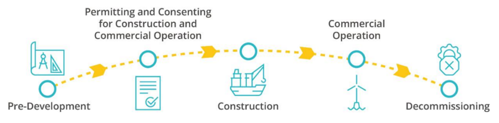
OSW projects are large infrastructure projects that need careful and long-term planning and are operated for 30 years. Each stage of the project lifecycle, from pre-development to decommissioning, has a specific set of works and different permits to be secured. An effective permitting system ensures that each phase transitions smoothly, reducing risks during the project lifecycle and allowing for adaptation to setbacks and changes. As these are capital-intensive infrastructure projects, a robust permitting system de-risks the projects to make them bankable.
The project found that a higher number of permits is required in the first two stages of the lifecycle, specific to the Philippines regulatory definitions:
Also notable among the project deliverables were case studies done on three countries with varying levels of OSW market maturity: Denmark, Scotland, and Taiwan. The end goal was to glean best practices from these countries, along with GIIP standards, in formulating recommendations for the Philippines’ OSW regulatory framework.
Based on these case studies and previous outputs, recommendations to the Philippines’ OSW permitting regime were presented in a series of workshops and consultations with the DOE and the DENR. Feedback showed that three recommendations should be prioritised:
As the Philippines continues its push toward renewables, the success of its still-fledgling OSW development will depend on a permitting regime that is both agile and efficient. While OSW has only recently gained momentum in the country, it stands to benefit from the wealth of experiences in more mature markets.
By combining global best practices and local insights, this project has laid the groundwork for a streamlined process, which reduces costs and risks, accelerates project timelines, and, ultimately, helps the Philippines achieve its renewable energy ambition.
Essential guidance for OSW development
The Offshore Wind Guidebook seeks to capture the OSW permitting process in the Philippines. Supported by NIRAS, it is the country’s first comprehensive overview of the permitting system in the nascent technology.