Project

Building resilience and hope in over 2000 households set to relocate due to future railway construction

STVC South Header

A project in the Philippines has helped more than 2000 vulnerable households affected by the South Commuter Railway Project prepare for relocation and improve their future prospects.

July 14, 2026
  • SDG: #1, #2, #3, #4, #5, #8, #10, #16
  • COUNTRIES: Philippines
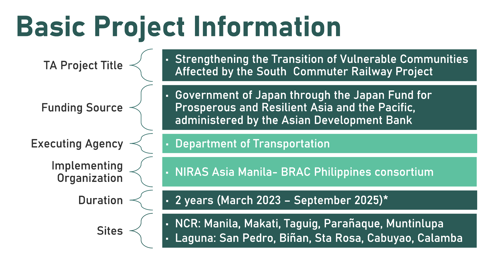
  • DONOR: Japan Fund for Prosperous and Resilient Asia and the Pacific
  • CLIENT: Asian Development Bank and the Government of the Philippines
  • CONTRACT VALUE: EUR 1,654,556 (USD 1,930,396)
  • DURATION: March 2023 - September 2025

Highly urbanised areas in the Philippines experience some of the most severe traffic jams, with current travelling conditions plaguing commuters. The city of Manila alone reportedly endures 98 hours lost due to traffic annually, slowing down economic activity and disrupting daily life.

Against this backdrop, Metro Manila and nearby urban centres are set to benefit from the construction of the 163-kilometre North-South Commuter Railway Project (NSCRP), which will ease congestion and improve mobility across Metro Manila, Bulacan, Pampanga, and Laguna provinces.

While the railway will bring significant mobility benefits, its construction also affects communities living along the rail corridor.

More than 14,000 households are required to relocate, highlighting the need for programmes like the “Strengthening the Transition of Vulnerable Communities Affected by the South Commuter Railway Project” — also known as STVC South or STVC SCRP — to support families through this transition.

Strengthening capacity and unlocking opportunities for the most vulnerable households

STVC South — a two-year technical assistance project funded by the Government of Japan through the Japan Fund for Prosperous and Resilient Asia and the Pacific (JFPR), administered by the Asian Development Bank (ADB), and executed by the Department of Transportation (DOTr) with technical assistance from NIRAS in partnership with BRAC — supported households affected by the South Commuter Railway Project (SCRP), which will form part of the North-South Commuter Railway Project (NSCRP).

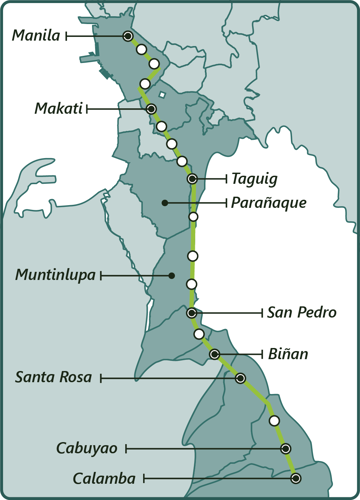
The goal of STVC South was to help non-land-owner, project-affected households strengthen financial stability by supporting livelihood options suited to their skills, capacities, and local context, particularly in select cities across Metro Manila and Laguna.

STVC South prioritised households facing multiple, overlapping challenges. Selection was based on a vulnerability assessment that considered factors such as age, disability, income, and other conditions that affect a household’s ability to cope with relocation and change.

For example, a household run by a senior citizen caring for persons with disabilities and earning below the poverty threshold was considered more vulnerable than a household experiencing only one or none of these conditions, and was therefore more likely to be included in the project.

To ensure that participating households received meaningful and sustained support, STVC South adapted the Graduation Approach, a framework developed by BRAC to help households move out of extreme poverty.

While traditionally applied in rural and settings with extreme poverty, STVC South was among the first to apply this approach to involuntary urban resettlement.

The project integrated lessons from the earlier STVC North experience and tailored the approach to respond to the realities of relocation linked to large-scale infrastructure development.

A total of 70 trained field mentors were deployed to deliver the project’s core interventions and provide regular coaching to participating households.

“Mentoring and coaching were central to STVC South’s project implementation,” says Team Leader Maria Benilda Redaja. “Field mentors guided participants through the resettlement process, helping them understand its rationale, plan for livelihoods, and connect with government and non-government services.”

The project’s progress and results were monitored using four outcome pillars: social protection, livelihoods promotion, financial inclusion, and social participation.

Before STVC South, the DOTr through NIRAS implemented a similar initiative under the Malolos-Clark Railway Project, known as the “Strengthening the Transition of Vulnerable Communities Affected by the Malolos-Clark Railway Project” (STVC North or STVC MCRP). Like STVC South, STVC North formed part of the North-South Commuter Railway Project (NSCRP). Lessons from this earlier project informed the design and delivery of STVC South. You can read more about the STVC North project in the link.

Over PHP 26 million

in total financial and in-kind support mobilised by the TA team

2500

households provided with capacity building and linkaging support

2232

household members completed financial literacy training

Measuring impact based on the STVC-adapted Graduation Approach

Households affected by the South Commuter Railway Project demonstrated strong progress across these outcome areas. Out of the 2500 households, 2489 (99%) successfully completed the programme with 2240 of these households (90%) meeting 75% of the key performance indicators.

Under the first pillar of social protection, support focussed on helping households access essential services such as healthcare, food assistance, and sanitation. Progress was tracked through indicators including the number of households that gained access to at least one food assistance program and those who participated in sanitation and hygiene training, including menstrual health.

Over the course of the project, food assistance and consumption support reached 2445 affected households, exceeding the original target by 5%. Awareness of hygiene and sanitation practices, including menstrual health, was strengthened among 2262 households, representing 98% of the target. In addition, 569 participating persons with disabilities were enrolled in government social insurance and assistance programmes, meeting 96% of the target.

Marites Malaluan STVC South
Marites Malaluan (centre, wearing a red shirt), together with other household representatives, attend the Livelihood skills training with Calamba Cooperatives and Livelihood Development Department.

For Marites Malaluan, a member of an affected household, attending training on making dishwashing liquid opened up new possibilities as her family prepared to relocate. With the skills she gained, she began producing and selling the product to earn additional income.

“Thanks to the training I attended, I was able to make dishwashing liquid and sell some already,” Marites shared. “For now, it helps contribute to my children’s daily allowance.”

Beyond skills training, many households also received business coaching to help them turn new skills into viable income sources. In total, 1958 household members (116% of the target) participated in business coaching sessions. One of them was Analy Tuburan, a housewife.

“The project taught me that I could do things I didn’t know how to before,” Analy said. “With the training, I learned how to start a business, when before all I knew was how to manage the home.”

To ensure effective delivery of these activities, the technical assistance team worked closely with government and non-government partners, strengthening access to practical, market-relevant skills.

In Calamba City, the “Calamba Cooperatives and Livelihood Development Department”, under the local government unit, provided hands-on training in candle making, meat processing, and dishwashing liquid production. 

1958

household members participated in business coaching sessions

990

household members completed financial management training

200

partner organisations coordinated by STVC South

Participating households also received starter kits to help them begin production, support that directly benefitted Marites. In addition, Calamba City’s Gender and Development Office delivered a two-day gender sensitivity training programme to 528 households, supporting the project’s social participation objectives.

In barangays across Laguna and Muntinlupa City, livelihood training was also delivered through the “Redemptorist Skills Training and Livelihood Programme”, implemented by the Redemptorist Church. 

Certified trainers provided instruction in food processing, manicure and pedicure services, haircutting, ear candling, and basic massage, reaching more than 200 household members and expanding their income-earning options.

Under financial inclusion, the project’s third pillar, results were also encouraging. A total of 2232 household members (90% of the target), completed financial literacy training and reported increased awareness of microfinance institutions, cooperatives, and mutual aid providers. In addition, 990 household members (87% of the target) completed financial management training, strengthening their ability to manage household resources and access available financial services.

Analy Tuburan STVC South
Analy Tuburan received her free medicine and eye consultation from Tzu Chi Eye Center.

Results under social participation, the fourth pillar, reflect affected households’ readiness to relocate and start anew. Key outcomes included 2407 households (97% of the target) reporting a clear understanding of the reasons for and requirements of resettlement. 

In addition, 1,793 households (102% of the target) took part in community-led activities that promoted their rights, interests, and well-being. A further 120 household members (111% of the target) were trained as peer coaches, enabling them to support fellow community members at relocation sites.

Given the project’s strong focus on gender equality and social inclusion, the technical assistance team also measured overall participation by women. Results showed high engagement by women, particularly in financial literacy and business coaching activities, reflecting the project’s efforts to expand access to economic opportunities.

Overall, the results suggest that households are moving beyond short-term coping toward more stable pathways after relocation. 

Progress across the four pillars indicates that the project successfully adapted the Graduation Approach to the context of urban resettlement, helping families prepare for relocation with practical livelihood skills, financial knowledge, and community networks to support their next steps.

Binan STVC South
Coaching and monitoring of mentor to two households in Biñan who are making rags post-training.

Mobilising partnerships and resources

A critical factor enabling STVC South’s impact was the number and strength of institutional partners that brought substantial resources. Rather than creating parallel support systems, the project focussed on helping households access existing government programmes and services designed for low-income and marginalized groups.

By the end of the project, STVC South had worked with more than 200 partner organisations. The total value of in-kind and financial support mobilised exceeded PHP 26 million (nearly EUR 400,000), serving a non-distinct total of 15,327 individual household members.

Contributions — a mix of social assistance, training and livelihood support, and relocation-related necessities — had come from national and local government agencies, foundations, private sector partners, and civil society groups.

Next steps to scale the project’s success

Knowledge sharing and strong institutional partnerships were undoubtedly fundamental to the project’s success, with both being key in expanding its impact. Through targeted capacity-building activities, the project team strengthened the institutional capacity of the DOTr to apply the Graduation Approach in complex, large-scale resettlement settings.

ADB Dotr South Commuter Railway Project STVC South
Photo from Asian Development Bank/Department of Transportation

Training interventions for government agencies focussed on practical, usable tools. These included a digital data management system (namely DAT.STVC, a tracking tool developed specifically for the project) and a context-specific Livelihood Restoration Support and Partnership Framework. The framework was co-developed with the DOTr, the Social Housing Finance Corporation (SHFC), and key line agencies to reflect the realities of large-scale railway infrastructure projects.

These efforts were complemented by the development of urban resettlement knowledge products, including policy briefs, case studies, audio-visual materials, and stories of change. 

The successful implementation of STVC has demonstrated the effectiveness of an enhanced livelihood restoration model for vulnerable households in an urban resettlement context. Building on these lessons, the project team and the DOTr are working together to refine the enhanced livelihood model for application in future resettlement programmes.

Overall, the lessons and innovations reinforced the project’s approach as a practical, replicable model for inclusive livelihood restoration in future resettlement programmes.

Lerna Melo Magdamo

Lerna Melo Magdamo

Senior Consultant- PM & QA

Manila, Philippines

+63 918 935 1589

Maria Frahn Chezka Tabajonda

Maria Frahn Chezka Tabajonda

Project Manager

Manila, Philippines

+63 917 703 5481