News
NIRAS secures major ‘Observatory’ mandate, strengthening our strategic research presence across Sub-Saharan Africa

News
As Africa becomes a new geopolitical centre of gravity, NIRAS has been selected to deliver a major new, multi-year strategic intelligence support platform commissioned by France’s General Directorate for International Relations and Strategy (Ministry of Armed Forces). This significantly extends our continental coverage and reinforces our role as a trusted research and monitoring partner.
Building on three years of successful research engagement in Francophone Africa, with this win, NIRAS expands our geographical and thematic reach across Eastern, Central, and Southern Africa. Alongside our ongoing Francophone Africa Observatory, this new mandate offers decision‑makers a coherent, complementary view from the Red Sea to the Mozambique Channel.
This Observatory also includes cross-cutting issues, such as maritime security or gender-based violence, private sector dynamics, and digital transformation – ensuring that our analysis captures both structural trends and emerging challenges across the continent.
Since 2023, NIRAS has partnered with French strategic institutions to implement the Francophone Africa Observatory, addressing critical dynamics across French-speaking countries. This has established NIRAS as a trusted partner delivering rigorous, operationally relevant analysis in complex and highly volatile environments.
The newly awarded Observatory represents a significant expansion in scope. It establishes a unified analytical framework covering Eastern Africa (including the Horn), Central Africa, and Southern Africa. This continental approach reflects both the interconnected nature of contemporary African challenges and France's evolving strategic engagement, in coherence with the European Union's priorities for security and development.
The regions covered by our expanded Observatory encapsulate major trends shaping 21st century global politics. Africa has become a theatre of intensifying great power competition while traditional partners recalibrate amid shifting public expectations. Security challenges — from gender-based violence (GBV) in conflict zones to violent extremism — coexist with economic dynamism and rapid demographic change.
Through four analytical axes, the Observatory converts this complexity into decision-ready insights:
Our approach rests on four pillars.
NIRAS’s expanding role reflects the evolution of a strategic partnership with French and European institutions engaged in navigating Africa’s rapidly shifting landscape. France maintains a notable presence through its forces in Djibouti (known as FFDj, Forces Françaises stationnées à Djibouti), which played a key role during the 2023 Khartoum evacuations, and through the French armed forces in the Southern Indian Ocean Zone (known as FAZSOI, Forces Armées de la Zone Sud de l’Océan Indien) in the Réunion island. These overseas territories also position France as the only EU member of the Indian Ocean Commission, offering unique strategic access for European engagement in the region.
Recent high-level diplomatic initiatives underscore renewed interest in Eastern and Southern Africa, including presidential visits to Madagascar and Mauritius (April 2025), and Kenya’s selection to host the 2026 Africa–France summit. These efforts, while nationally driven, align with broader European objectives and require robust analytical support to succeed in an increasingly competitive and multipolar environment.
Our two Observatories provide this support through rigorous, evidence-based research by teams with strong regional expertise. We mobilise networks of local researchers, international experts, and institutional partners to generate original insights. Our methodologies are adapted to crisis contexts, maintaining ethical standards and quality control even in fragile or conflict-affected environments.
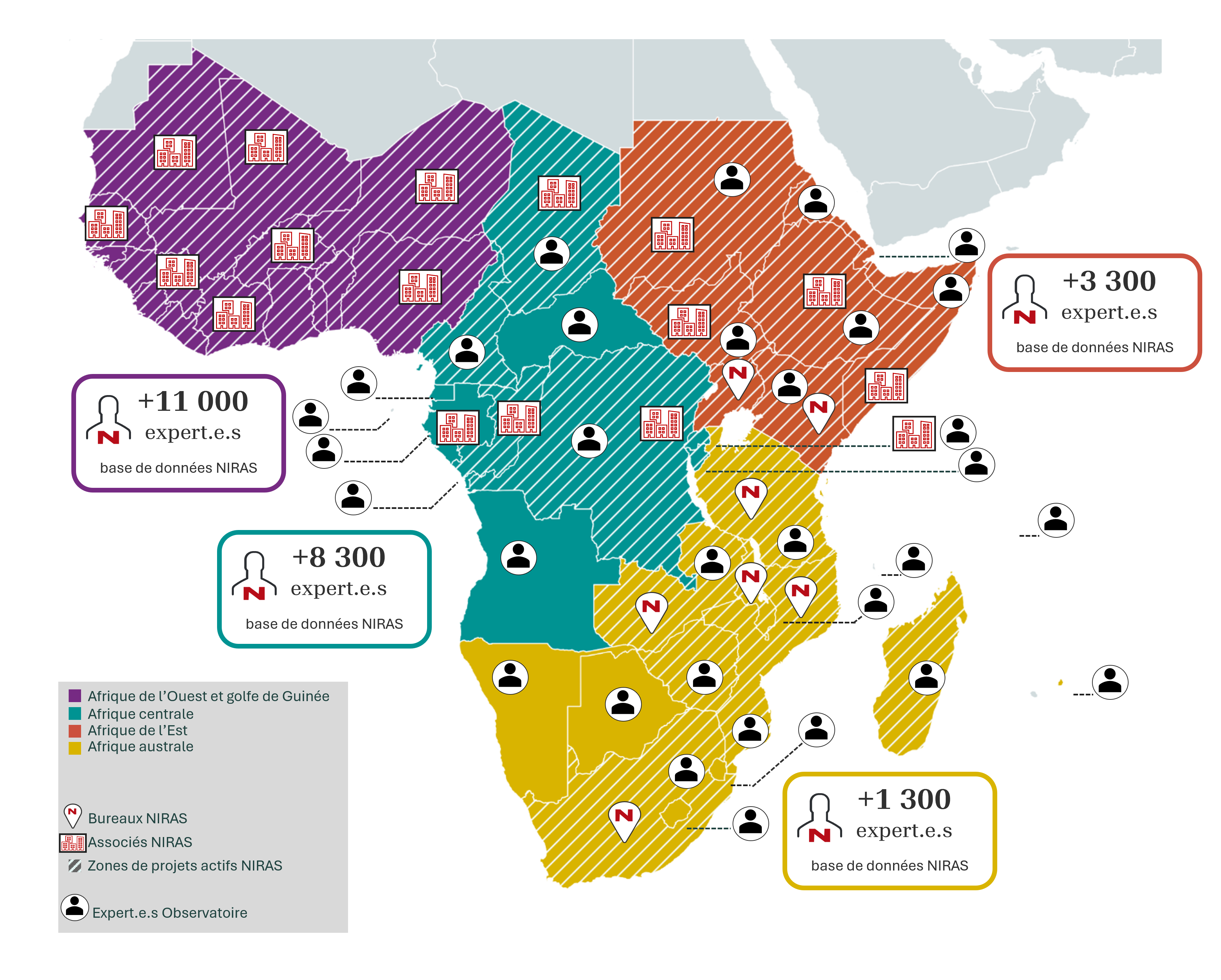
The map below features the related NIRAS network and Observatory experts.
As Africa's punching weight in global affairs continues to grow, the need for nuanced, contextualized analysis becomes critical. NIRAS France's expanded continental coverage positions us to serve as a bridge between African realities and French and European strategic interests, between academic research and operational decision-making, between local knowledge and global perspectives.
Through our two Observatories, NIRAS contributes to this understanding, providing strategic intelligence necessary for informed engagement in Africa's critical transformation period. Our work demonstrates that rigorous methodology, institutional expertise, and operational focus can combine to produce analysis that serves strategic decision-making in an increasingly complex world.