Leading when nothing can be taken for granted

Maryna Bryl NIRAS Portrait Banner

"What attracted me to NIRAS was the combination of international experience and a pragmatic working culture," Maryna says. "For a project like UCORD, that balance is extremely important."

Maryna Bryl is the Team Leader of Ukraine’s Cohesion and Regional Development (UCORD) Project. Funded by the Swiss Agency for Development and Cooperation (SDC) since 2022, UCORD supports Ukraine’s recovery and European integration by strengthening the country’s regional development system and helping translate policy priorities into practical results at regional and local levels. A major part of this work is bolstering Regional Development Agencies (RDAs) as important actors in regional development – capable of bringing together public authorities, hromadas (municipalities), businesses, academia and other partners around regional priorities, investment opportunities, and development initiatives. RDAs are supported through core funding, training, mentoring, and technical assistance, while helping them build their capacity in strategic planning, project development, investment coordination and partnership building. UCORD connects national, regional, and local levels, supporting the key government partners of Ukraine - Ministry for Communities, Territories and Internally Displaced Persons, Ministry of Economy and Environment, Ministry of Culture, and - and helping create stronger links between national policies, regional strategies and implementation on the ground. In doing so, the project contributes not only to Ukraine’s immediate recovery, but also to building the institutions, partnerships and capacities needed for longer-term, place-based development and Ukraine’s future participation in EU cohesion policy. We had the chance to speak with Maryna about her work and the challenges of leading such a complex project in the midst of the Russia’s full-scale war against Ukraine

Can you tell us a little about yourself and the path that eventually brought you to NIRAS and UCORD?

I have spent a large part of my professional life working in international development and, particularly, in regional and local development in Ukraine. Before UCORD, one of the most important chapters for me was DESPRO, another Swiss-supported project, where I was part of local self-governance reforms in Ukraine and gained a very practical understanding of decentralisation, local governance and what it actually takes to turn reforms designed at national level into changes that people can see in their hromadas.

So, in a way, coming to UCORD was a natural continuation and part of my career growth. UCORD works with regional development. This is a broader – regional level that requires immediate reforms, in particular in view of Ukraine’s EU accession processes. We deal with national policy and partnerships building with oblasts ─ enhancing their economic and investments potential growth ─ capacity building of regional development agencies, and support to regional infrastructure development. For me, the project brought together much of what I had learned before, but on a larger and more ambitious scale

And then, of course, the context changed dramatically. Today, regional development in Ukraine cannot be separated from resilience, recovery and European integration. That has given the work an entirely different meaning.

Maryna Bryl NIRAS Portrait 02
"UCORD was not designed as a project that simply delivers a series of activities. Its ambition is to influence how regional development works in Ukraine," Maryna notes.

What attracted you to NIRAS, and what made you want to take on the leadership of a project as ambitious as UCORD?

I think it was precisely the ambition that attracted me.

UCORD was not designed as a project that simply delivers a series of activities. Its ambition is to influence how regional development works in Ukraine: how national policy connects with regions, how regional institutions become stronger, how projects move from ideas to investment, and how regions build partnerships and economic opportunities.

That is both exciting and difficult. You cannot achieve it by following a project document mechanically. You have to constantly understand what is changing around you and adapt without losing sight of the overall objectives.

What attracted me to NIRAS was the combination of international experience and a pragmatic working culture. There is access to expertise from different countries, but at the same time there is room for the Ukrainian team to lead. For a project like UCORD, that balance is extremely important.

What has surprised you most about working with NIRAS — or about being part of an international company while leading a very Ukrainian project?

Probably how much the two worlds can complement each other. This comes also from my previous experience of working in the UN in Ukraine. It was hugely beneficial to attract multiple international experience and expertise of UN representatives to Ukraine.

UCORD is deeply Ukrainian. The problems we work with, the institutions, the political and administrative environment, and certainly the wartime reality require very strong local knowledge.

At the same time, being part of an international company gives us access to experiences that Ukraine can learn from — and increasingly, I think, experiences that others can learn from Ukraine.

I particularly value situations where international experience is not presented as a model that Ukraine should simply copy. Instead, we can ask: how does this work in Switzerland, Sweden or another European country? Why does it work there? And which elements could realistically work in Ukraine? For me, that is what international cooperation should be about: not importing solutions but creating better ones together.

Maryna Bryl NIRAS Portrait 01
For Maryna, working with an international organisation like NIRAS, while leading a "deeply Ukrainian" project, allows for an exchange of ideas and experiences that UCORD can benefit from.

UCORD is a large and complex programme even under normal circumstances. What does it mean to lead a project of this scale while your country is at war?

You can have a carefully prepared workplan, and then an air raid, an attack on infrastructure, mobilisation, security restrictions or another completely unexpected development changes the situation overnight.

But the project still has commitments. Partners are waiting for decisions. Grants have to be implemented. Infrastructure has to be built. Reports have to be delivered. And, importantly, people are depending on you to provide some sense of direction.

I think leadership under such circumstances means learning to distinguish between what is urgent and what is truly important. It also means that having flexible approaches does not mean poor planning. In Ukraine today, flexibility is part of good management.

At the same time, war makes our work even more important. Ukraine cannot wait until the war is over to build stronger institutions, prepare investments or develop its regions. Recovery is already happening, and preparation for our European future starts now.

For people outside Ukraine, it can be difficult to understand what everyday life looks like now. How has the war changed your daily life — both personally and professionally?

Perhaps the strangest thing is how abnormal things gradually become normal. You learn to check the air-raid alerts together with your calendar. You know where the nearest shelter is. You think about electricity and internet connectivity in ways you never did before. You may have had a difficult night because of an attack and still have an important meeting at nine in the morning.

Professionally, there is always this second layer of reality behind the normal working day. Someone's family member may be serving in the army. Someone may have spent the night in a shelter. A partner organisation may suddenly have completely different priorities because its hromada has been attacked.

And yet life continues. We work, meet friends, make plans, travel when we can, laugh and celebrate birthdays. I think this is something that can be difficult to explain to those outside Ukraine: resilience is not about being heroic every day. Very often it is simply the decision to continue living a normal life in circumstances that are anything but normal.

Maryna Bryl NIRAS Portrait 04
"I think [engaging with activities outside your job] is healthy and brings you energy for your new ideas and for the next day’s work," Maryna says on what she does to stay energised to take on a huge endeavour like UCORD. "And there is another source of motivation: seeing something become real. [This reminds] me why all the difficult processes behind them are worthwhile."

How do you lead and motivate a team when everyone is dealing not only with the pressures of work, but also with the personal uncertainty and strain of war?

The best motivation for everyone nowadays is to understand why the work matters and to know that everyone is trusted to implement their work.

I am quite demanding as a manager. I care about quality, deadlines and responsibility, and the war has not removed those expectations. But I think it has made me much more conscious that there is always a human being behind a deliverable.

Sometimes leadership means pushing because something really needs to be done. Sometimes it means asking, "What is preventing us from moving forward? What can be done under such circumstances?" And sometimes it means recognising that today a person simply has more important things to deal with than a project deadline. 

The difficult part is finding that balance. Empathy cannot mean that standards disappear, but standards also cannot make us forget the circumstances in which people are working.

Has the experience of the past few years changed you as a leader? What have you learned about yourself?

Definitely. I think I have become more comfortable making decisions without having perfect information. Before, I probably wanted to analyse things until I was completely sure. Today I know that sometimes you have 70% of the information and still need to decide.

I have also learned that I am more resilient than I thought — although I have also learned that resilience has limits. And perhaps most importantly, I have become more interested in whether we are moving towards the right result. You need good team, clear expectations, and enough trust to let the team do their jobs.

Maryna Bryl NIRAS Portrait 10
Maryna (right) during a UCORD event

When the immediate pressures of the job become overwhelming, what keeps you motivated?

First of all, the team. I am fortunate to work with people who are highly professional, independent and genuinely care about what they are doing.

But I also need things that have absolutely nothing to do with work. I love aerial gymnastics, skiing in the Ukrainian Carpathians, and sailing. They all require concentration in a very physical way. When you are several metres above the floor on aerial silks, you cannot simultaneously think about budgets, procurement or tomorrow's meeting.

I think that is healthy and brings you energy for your new ideas and for the next day’s work.

And there is another source of motivation: seeing something become real. A regional development agency becoming stronger and a contact point for international partnership. A partnership that did not exist before. An infrastructure project moving from paper towards implementation. A Ukrainian institution beginning to do something independently that previously required external support. Those moments remind me why all the difficult processes behind them are worthwhile.

You are working on regional development at a time when Ukraine is simultaneously fighting a war, rebuilding and preparing for a European future. What does being part of that process mean to you personally?

It is probably the most meaningful part of my professional life. Ukraine has an extraordinary challenge ahead of it, but also an extraordinary opportunity. We are not simply rebuilding what has been destroyed. We have the possibility to rethink how the country develops, how investment decisions are made, how regions participate in those decisions and how our institutions work within a European framework.

For me, regional development is fundamentally about places and people. Ukraine's recovery cannot be successful if it is only designed in Kyiv. Different regions have different economic structures, demographic challenges, assets and opportunities. They need the capacity to understand those differences and turn them into strategies, projects and investments.

If the work we are doing now helps Ukraine become a more capable, decentralised and genuinely European country, then being able to contribute to that is an enormous privilege.

Maryna Bryl NIRAS Portrait 06
"We are not simply rebuilding what has been destroyed. We have the possibility to rethink how the country develops," Maryna shares.

What does an ordinary day look like for you now — if there is such a thing as an ordinary day in Ukraine?

There probably isn't an entirely ordinary day. It usually starts with checking my phone — and unfortunately that can mean checking what happened during the night before checking my emails.

Then the working day can move very quickly between completely different levels: a discussion with a ministry, a decision on a grant or procurement issue, a meeting with the Swiss partners or NIRAS, a conversation with one of our regional development agencies, reviewing a report, solving an implementation problem, and then suddenly dealing with something that was not on the agenda at all.

There are usually many calls and probably too many messages. And somewhere between all of that, there is normal life: coffee, conversations with colleagues, trying to find time for sport, friends and family. Maybe that is what an ordinary Ukrainian day is now — an unusual mixture of very serious circumstances and completely ordinary human life.

What is something you are looking forward to doing when Ukraine is at peace that you cannot do today?

I think the first thing is not something spectacular. I want to experience what it feels like to make plans without mentally adding the words "if everything is okay."

I would love to travel freely around Ukraine again — to fly from Kyiv airport to any country in the world, to the mountains, to Crimea and the Black Sea, to the places that today are inaccessible or unsafe — without checking alerts, restrictions or security conditions, to meet with my friends in Kharkiv or to visit a project site in Sumy. 

And I would like to experience silence differently. Not the kind of silence where you are listening for the next sound or in-between explosions, but the ordinary kind where nothing is happening and nothing is supposed to happen. I am dreaming about listening silence and not sirens.

I think peace will make us appreciate many very simple things that we once considered completely normal.
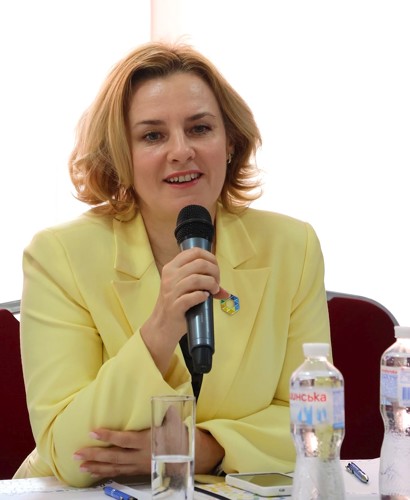


When you allow yourself to look beyond the war, what do you hope life in Ukraine — and your own life — will look like in five or ten years?

Professionally, I hope we will look back at this period and see that many of the institutions and approaches we are building now became part of a stronger Ukraine and eventually part of Ukraine's membership in the European Union.

Personally, I would like something much simpler: more freedom to travel, spend time with my family and people I care about, and make plans because I want to make them rather than constantly calculating what circumstances may allow.

Perhaps after years like these, an ordinary peaceful life starts to look like an extraordinary luxury.

And finally, when UCORD eventually comes to an end, what would make you look back and think: “Yes, we achieved something that really mattered”?

For me, success would not be that people remember UCORD.

In fact, one of the best signs of success in development cooperation is when the project itself is no longer needed.

I would like to see strong oblasts and regional institutions, in particular regional development agencies, that can prepare quality projects, attract investments, build partnerships, construct stronger regional identity and work confidently with national and European programmes. I would like to see regional strategies connected to real financing and implementation rather than remaining documents on shelves. And I would like some of the approaches we are developing — including better use of data, stronger regional coordination and project pipelines preparation — to become normal practice.

If, several years after UCORD has ended, these things continue without us and nobody needs to ask who originally supported them, I would consider that a very good result.

You can learn more about UCORD on their website

Get in touch:

Anastasiia Yermoshenko

Anastasiia Yermoshenko

Country Director Operations

Stockholm, Sweden

+46 76 568 68 23

Ukraine

NIRAS in Ukraine

For more than 25 years, NIRAS has worked alongside Ukraine’s government bodies at all levels ─ national, regional and municipal ─ as well as with utilities, private companies, international financial institutions, donors and development partners to design and implement reforms and projects that improve the well-being of the Ukrainian people. To date, we have been entrusted with and completed more than 35 projects in Ukraine and continue to manage a substantial portfolio of ongoing recovery, reform and technical assistance programmes. Today, we are implementing a broad portfolio of projects across the country.

Grisha In Torit

Balancing the Books and Life in Wartime Ukraine

“If there are explosions, I will have to stop the call,” he says casually from his desk by the window in Kyiv where he is based. “But it should be fine.” A gentle reminder to those of us who sometimes forget about the daily impact of the war still raging on Europe’s doorstep that has taken so many Ukrainian lives. But Grygoriy – or Grisha as most know him – is unperturbed and at the office where you can find him also often on the weekends.

Yuliia Ivanus Meet Our Employees NIRAS 01 (1)

A young student takes every opportunity she can to see a free Ukraine

In Ukraine, she explains how students often bring a tourniquet and medical kits in case of a missile attack. "It's a very small part of something unusual we have to face each day," she says. "We want to live, hopefully in a few years, without missiles, but that's the context we are living today." Despite the exhaustion of years of war, she says people continue to find reasons to keep going.

Ukraine Recovery Conference thumbnail

NIRAS in Ukraine: Committed to rebuilding

In more than 25 years, NIRAS has supported Ukraine through projects in various areas—from agriculture and infrastructure to governance—for international organisations and private-sector clients. This support continues.