


Smallholdr website
Smallholdr is a customised mobile app and web-based platform for collecting and analysing data, managing field teams and tracking produce in smallholder supply chains
Insight
Working with Uganda’s Ministry of Water and Environment under the World Bank-supported Investing in Forests and Protected Areas for Climate-Smart Development (IFPA-CD) project, NIRAS and its partners helped 5,334 farmers plant 4,000 hectares of commercial woodlots across 19 refugee-hosting districts reaching +37,000 people. In this blog, IFPA-CD’s Project Director Karen Smith explains how the 'Smallholdr' app and dashboard helped turn field data into practical decisions: where to deploy staff, how many seedlings to supply and which planting sites needed attention. She looks back on the development of the system alongside project delivery and explores how it supported delivery within just nine months.
At the design stage of the project Smallholdr, a UK-based agricultural data platform, was selected as the project data collection and management system. As co-founder and former Managing Director of Smallholdr, I knew it could deliver what was needed. Smallholdr’s advantages include that its solutions are bespoke to each project / client need and it models the real world. Any information collected about an entity (such as a farmer or a parcel of land) is always connected directly to that entity's record in the database - there are no separate data manipulation steps needed to match up records.
This inherent ‘semantic’ design, coupled with the rapid transfer of field data from the app to the cloud-based database, means that data is not only immediately available but it is immediately usable.
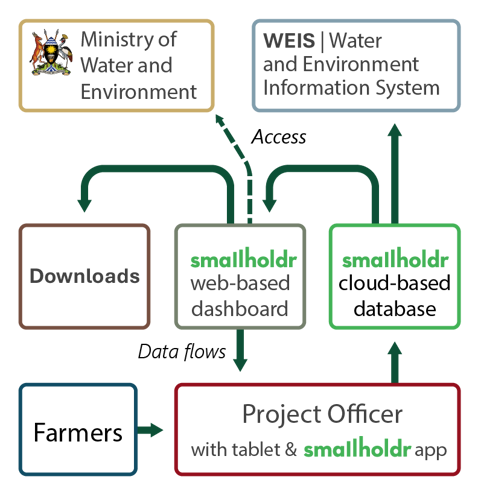
The Smallholdr team would normally run a ‘discovery phase’ to understand a client's needs before building a system. However, due to factors outside our control, the project duration was shortened from three years to just nine months. This left us with the daunting challenge of starting up a huge logistical project, recruiting and training a field team, enrolling thousands of farmers and supplying them with millions of seedlings to plant in just one season (three months). There was simply no time for a discovery phase — we had to build the system in stages or ‘sprints’ without having a masterplan set out in advance. The diagram below sets out the overall functional vision for the system.
A vital first step was to set up the geographic structure, which meant identifying all 171 parishes in which we would be working. Only six weeks into the project, in November 2025, our team conducted inception meetings in the 19 target districts, cascading to parishes identified by the local authorities. Having parish names meant dropdown menus could be used in the app for each farmer’s location — we could not afford to have errors caused by misspelling of names.
In parallel, we worked with the Smallholdr team to get the first survey (farmer application) designed, tested and live. In mid-November we held a training session where we handed out the tablets and introduced the field team to the app, and they deployed in late November to sensitise communities and begin collecting farmer applications. The first data arrived in the dashboard in late December and, although there was a rather stressful hiatus in activity over Christmas and then into mid-January due to the Ugandan elections, watching the numbers tick up was highly rewarding.
From this point, we continued designing further surveys as fieldwork progressed, staying one step ahead of what was needed on the ground — “flying the plane while we were building it”. We used a spreadsheet to capture and refine the questions for each survey to share and discuss with the Smallholdr team. A test version of the app was used to trial each survey and fix any issues before going live. The graphic below depicts the nine-month journey and some of the key events and results achieved.
Design principles: There were several key principles we used for survey design: keeping the surveys as short and simple as possible, using dropdown selections rather than free text entry where possible to reduce errors and designing the surveys so that they minimised the number of visits to each farmer. This last point was important as the time taken to reach a farmer and collect information was a key delivery constraint. Surveys 2-5 — which tested the eligibility of a farmer and their proposed parcels, mapped the parcels and took their seedling orders — were all designed to be completed in a single visit to a farmer. The final version of the app included 11 surveys covering over 100 data points, including farmer demographics, plot suitability, plot perimeter co-ordinates and seedling orders.
Flexibility: Throughout the implementation, we were able to adapt and improve surveys if needed, working closely with the Smallholdr team. As an example of the system’s flexibility, when the new field staff were deployed they needed to be ‘roving resources’, moving to where they were most needed rather than being assigned to fixed districts as the original field staff were. Smallholdr's design meant we could dynamically change the location settings on each field worker’s app so they had access to farmer records in the parish in which they were working. The system also enabled us to adapt quickly to rapidly changing conditions on the ground. When farmers reported that they could no longer plant the number of seedlings originally planned, the team adapted the readiness check survey to capture the proportion of land they were now able to plant. This information was used to automatically recalculate the appropriate number of seedlings for each farmer, allowing allocations to reflect their actual planting capacity. This helped minimise seedling wastage while ensuring support remained responsive to farmers’ changing circumstances.
Data quality: Smallholdr’s in-app calculations were essential for quality control, for example to automatically calculate parcel areas from mapped perimeters, reducing reliance on farmers’ estimates. Each farmer was asked for the proportions of seedling species they wanted to grow and in-app metrics on seedling spacing per species would then automatically work out the number required of each – with a percentage buffer built in. These inbuilt design features helped us calculate seedling quantities accurately, based on mapped areas, species choices and spacing requirements.
Quality assurance and user support: Once a survey went live, we monitored the dashboard closely to check field officers were using it as intended, running spot checks per officer. This caught misunderstandings early – for example, an officer photographing the plot of land instead of the completed form. Errors were typically easy to correct, as they tended to be the same mistake repeated by an individual. Once an error was caught, the MRM team would liaise with the field team to make the corrections. Throughout the delivery period the field team received trainings and refreshers on using the app and had WhatsApp support groups to resolve any problems quickly.
Q&A sessions during trainings and refresher sessions created a direct feedback loop between field teams and app development, allowing usability issues to be identified and addressed quickly. For example, field staff highlighted that farmers within the same parish may share the same name, making it difficult to select the correct farmer when entering data. In response, unique identifiers were added alongside farmer names in the app, reducing ambiguity and making data entry easier for field officers. A live Frequently Asked Questions document provided an additional first point of support and was continually updated as new surveys were introduced and new questions emerged.
The online dashboard – a tool used by the management team – was easy to explore in detail: from a farmer's page, one could drill down to parcel information including its geo-located perimeter map and size; from there, into an associated seedling order, and further still into the detail of that order.
In mid-January we conducted a scenario planning exercise to work out how many farmers we could realistically support and how much land they could plant – a major decision given rains were due to start only six weeks later. The data we were seeing on the number of farmers a field worker could reach per day as well as the average parcel size were key variables in the calculations. The results of the analysis led to the decision to recruit another 27 field staff immediately to help farmers plant the target area – more than doubling the size of the team.
As data volumes grew, particularly once all farmers were enrolled and seedling orders taken, we downloaded data to Excel and used Power BI for further analysis. This was critical during the planting season for tracking how many seedlings had been planted by parish and district and identifying gaps. This information was used by the management team in meetings with field team managers to direct effort where it was most needed in order to meet targets. On a daily basis we could see how many farmers had been enrolled and how many parcels had been marked “ready for planting”, helping us make timely decisions. Even a lag of a few days between data arriving and being analysed would have significantly hindered us, particularly in the later stages, when we were delivering seedlings in batches matched exactly to what farmers had ordered at parish level.
IFPA-CD’s scale and speed of delivery were underpinned by a digital system that turned real-time field data into practical decisions, allowing resources and effort to be directed where they were needed most. Smallholdr was not simply a monitoring tool, but a core part of the delivery model, bringing structure, quality control and flexibility to a highly complex operation.
The longer-term potential is even greater: if systems like this are owned and routinely used by permanent actors, such as government agencies and local forestry or agricultural players, they can strengthen coordination, market linkages, technical knowledge and overall economic returns well beyond the life of a single project.
Karen Smith
Economic Development & Agriculture Lead NIC UK/Africa
Edinburgh, United Kingdom
Taylor Martin
Principal Consultant (Climate Change)
Edinburgh, United Kingdom

Smallholdr is a customised mobile app and web-based platform for collecting and analysing data, managing field teams and tracking produce in smallholder supply chains

With support from the World Bank through the Investing in Forests and Protected Areas for Climate-Smart Development (IFPA-CD) Project, NIRAS and its partners worked with host communities across western and north-western Uganda to establish small-scale commercial woodlots on private and customary land, helping to improve livelihoods, strengthen climate resilience, and reduce pressure on natural forests.

A female farmer has shifted from bean crops to woodlots, and a young council leader urges his peers to tend the land they will someday inherit. Although quite some distance apart and facing different circumstances, both found a common answer to help ease the weight of climate change and economic insecurity: tree planting.