Women play a vital role in Uganda’s forestry sector, from raising seedlings to managing woodlots and trading forest products. Drawing on lessons from the World-Bank funded Investing in Forests and Protected Areas for Climate-Smart Development (IFPA-CD) Woodlots Project, Taylor Martin, our Climate Change Consultant, reflects on how greater inclusion of women in forestry is creating economic opportunities, strengthening livelihoods, and supporting more inclusive household decision-making.
October 14, 2026
Every year on 15 October, the International Day of Rural Women celebrates the women who grow much of the world's food, steward its natural resources, and hold rural households together. Across Uganda, women and girls are helping restore landscapes, strengthen livelihoods, and create opportunities for future generations.
Through the IFPA-CD Woodlots Project, thousands of households established commercial woodlots for small-scale production across Uganda's refugee-hosting districts. The project's experience highlights the vital role women already play in forestry and demonstrates practical ways to support their participation and leadership.
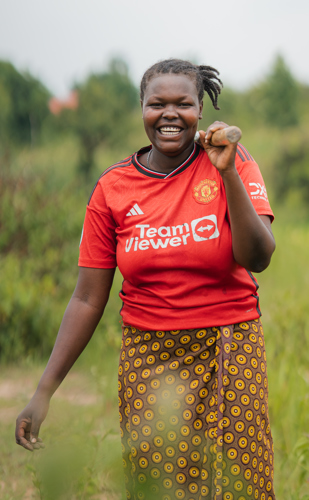
Ms Mugabirwe Novenci, owner of Brain Central Tree Nursery
Growing seedlings and livelihoods
Forestry is often seen as a male-dominated sector in rural Uganda, yet women play vital roles across the value chain. They raise seedlings, plant and tend trees, manage woodlots, collect non-timber forest products, and trade forest goods.
Their contribution is particularly visible in nursery enterprises. Nine of the certified nurseries supplying the project were women-owned, together providing 18% of all seedlings supplied to farmers. In the Mid-West region alone, women owned five of the 18 certified nurseries. Among them is Brain Central Tree Nursery in Kamwenge District, which Mugabirwe Novenci established over a decade ago.
16%
of the 5334 farmers who established woodlots were women
+20%
of prequalified nurseries that supplied seedlings to the project were women-owned (nine in total)
4500000
seedlings distributed
A single mother raising four children, Mugabirwe built the nursery into a business that now employs nine permanent staff, five of them women, and takes on extra seasonal workers at peak periods. "Many women today are heads of families. They carry the responsibility of feeding their children, paying school fees, rent and medical bills. Empowering women with skills helps them build sustainable businesses and even create jobs for others," she explains.
One of those jobs belongs to Mary Tumukunde, 62, who has worked at the nursery for more than eight years while caring for her three grandchildren. "Even though I cannot do heavy work, I contribute through pruning and potting seedlings. It gives me satisfaction to be part of this work and to support my family”, Mary says. Her story shows how women-led forestry enterprises create work for other women in their communities."
Tree farmer in Koboko District
Unlocking opportunities for women
Despite their significant contributions, women face barriers to participating fully in commercial forestry, particularly limited access to land, finance and decision-making. Land is the biggest hurdle, with only 16% of land held in women’s names.
The project's own figures reflect this. Women represent 16% of the 5,334 farmers who established woodlots but only 12% of the 4,010 hectares planted. On average, their woodlots were about 0.57 hectares, roughly 30% smaller than men's at 0.79 hectares.
This gap mirrors wider patterns of land inheritance. Land is often passed through male lineage, limiting women’s ability to make long-term investments in forestry, where returns can take years to materialise.
Women's participation also varied widely across districts, reaching 27% in Moyo and Kamwenge, compared to just 6-7% in Terego and Arua, highlighting the influence of local social and cultural norms that shape who takes part.
Access to labour can be another challenge. Establishing a woodlot requires significant effort for land preparation, pitting and planting, creating additional barriers for women-headed households, older people and persons with disabilities.
Family farmers in Koboko District
A family approach to change
One of the project's most effective approaches was to treat the household, rather than the individual farmer, as the primary unit of participation. During enrolment, family members were asked to endorse the decision to take part so that the investment had backing across the household.
Families developed livelihood and land-use plans together, aligning species selection with household goals, market opportunities, and available land. Spouses, children, and relatives also participated in training on land preparation, planting and woodlot management, helping address labour constraints while promoting more inclusive decision-making.
The approach also gave women a stronger say over land use. Households had to keep enough land for food production, and because women often lead on household food security, they were frequently key voices in deciding how much land could go to woodlots.
Targeted household engagement opened new doors, too. In Kyegegwa District, farmer coordinator Laban Tunanikirwe allocated part of his land to his wife, Rossette Tusemerires, who established half an acre of eucalyptus (about 0.2 hectares). In Moyo District, Lojoki Agnes, a mother of five, negotiated access to one acre (about 0.4 hectares) of family land for pine. She plans to use future timber revenues to support her children's education, while her success has already inspired other women in her community to consider establishing woodlots of their own.
Family farmers at work
Inspiring the next generation
The next generation is helping drive change as well. After learning about tree planting at school, 15-year-old Jazila Ababiku encouraged her parents to establish three acres of Gmelina arborea and eucalyptus. The family set aside one acre to their six children, who now help care for the trees. They hope the timber will one day pay for education, healthcare and household needs.
The project showed that real progress is possible when women and whole households are actively engaged in forestry. Yet the wide variation in participation between districts, from 27% in Moyo and Kamwenge to just 6–7% in Terego and Arua, highlights that changing long-standing norms around land ownership and decision-making takes time.
Building on these foundations will require continued engagement with community, clan and traditional leaders who influence how land is accessed and used. It will also mean supporting local champions such as Mugabirwe and Lojoki Agnes, whose success is already encouraging other women to invest in tree growing.
This International Day of Rural Women, the trees planted by families like Jazila's are growing alongside something equally important: opportunity. By enabling more women and girls to participate, lead, and benefit, forestry can deliver lasting gains for households, communities and the landscapes they depend on.
Special thanks to Gladys Nagawa, Gender Specialist on the IFPA-CD Woodlots Project, for her guidance on gender and social inclusion and for her contributions to the development of this article.
Karen Smith
Economic Development & Agriculture Lead NIC UK/Africa