Project

Understanding Whooper Swan migration and their interaction with offshore wind farms

Eileen With Whooping Swan V2

Eileen Rees (renowned for her international research and conservation of swans and other waterbirds) holding a Whooper Swan. Photo credit: Richard Green, Environment & Consents Senior Project Lead at Ørsted.
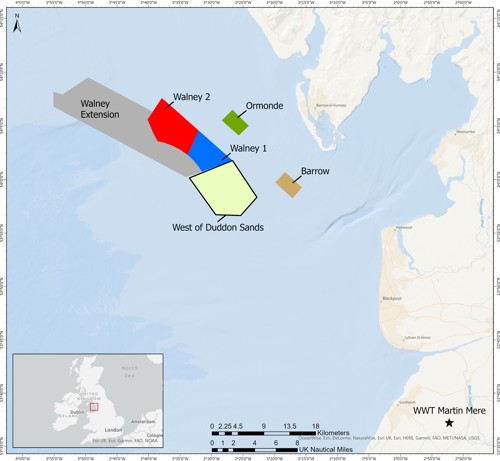
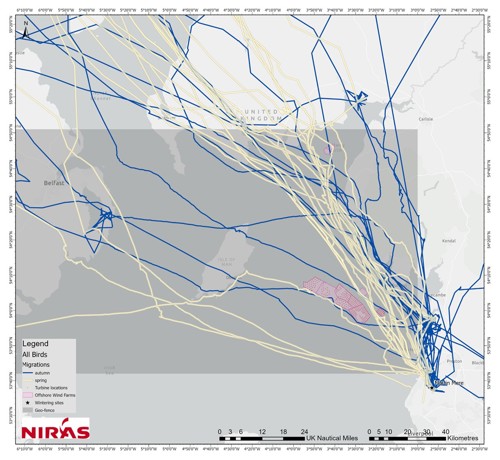
Every spring and autumn, Whooper Swans make the long journey between Iceland and their wintering grounds in Britain and Ireland. Many cross the Irish Sea, an area now home to several offshore wind farms. To better understand how these migrations overlap with offshore development, NIRAS worked with WWT Martin Mere, supported by Ørsted and ScottishPower Renewables, to track the birds’ movements in detail.

November 20, 2025
  • SECTORS: Environment and Ecology
  • COUNTRIES: United Kingdom

Twenty female Whooper Swans were carefully caught by experienced, licensed ringers, using WWT’s traditional swan pipe and were fitted with Ornitela GPS/GSM collars. These small, lightweight devices recorded each bird’s position every second within defined zones, capturing a level of detail that was previously impossible.

Most birds that transit the offshore waters surrounding west coast Cumbrian Offshore Wind Farms are birds moving to/from the wintering population cantered upon WWT Martin Mere Wetland Centres in NW England

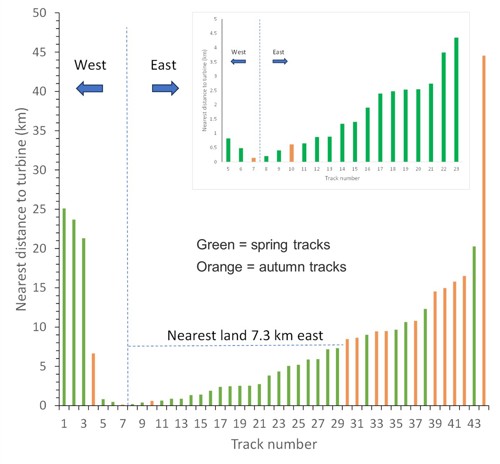
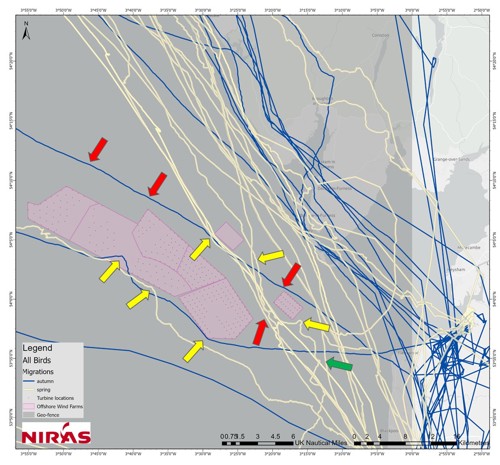
Over four migration seasons, the team gathered 44 full flight tracks, 31 in spring and 13 in autumn. The data revealed a clear and consistent pattern: the swans maintained safe distances from operational wind farms, showing what’s known as macro-avoidance behaviour. Of the 23 tracks that brought birds within six kilometres of a wind farm, 15 showed deliberate changes in trajectory, altitude or direction, often well before they reached turbine arrays.

A broad range of seasonal migration routes flown with no obvious seasonal differences when transiting the region - image shows spring and autumn migration routes

Whooper Swan nearest turbine figure

No birds entered a wind farm area, and the nearest approach recorded was 140 metres, when one swan flew low past a site under a full moon. Importantly, there was no difference in behaviour between day and night, and the collars showed no sign of affecting the birds’ natural movement or health.

These findings add valuable evidence to how offshore wind and wildlife can coexist. By combining advanced tracking technology with field expertise, the study demonstrated that Whooper Swans naturally adapt to the presence of turbines, helping confirm that operational wind farms pose a low risk to this species.

Macro-avoidance behaviour - 14 to 18 tracks within 4km were interpreted as showing avoidance behaviour

For NIRAS, projects like this are about practical understanding,  using good data to see how wildlife responds to change. Studies like this help build confidence that renewable energy can grow without compromising the wildlife and habitats around it.

Get in touch

Paul Watts

Paul Watts

Marine Environment Associate Director

Ascot, United Kingdom

+44 07974 902532

Robin Ward

Robin Ward

Technical Director

Ascot, United Kingdom

+44 7912 287544