Project

Helping Nepal turn climate priorities into investment

Istock 635999180

With funding from the Asian Development Bank, NIRAS is leading technical assistance to help design and develop Nepal’s Green and Resilience Financing Facility (GREFF), to prepare projects for financing with a proposed first phase focused on agriculture, agribusiness and rural development. 

October 9, 2026
  • SDG: #2, #11, #13, #15, #17
  • Sector: Development Consulting
  • Country: Nepal
  • Client: Asian Development Bank (ADB)
  • Contract value: USD 1,687,519 
  • Duration: June 6, 2025 - Dec 30, 2026 

Nepal faces the increasing effect of climate change that threaten its economy, communities and livelihoods. Addressing these risks requires significant investment in climate-sensitive sectors of Nepal. Yet securing finance takes more than identifying a need. Projects must be developed into viable proposals, suitable funding sources brought together, and the costs of arranging finance kept manageable. 

With funding from the Asian Development Bank, NIRAS, in collaboration with Application Européenne de Technologies et de Services (AETS) and Water Asia International, is providing technical assistance to design and develop the Green and Resilience Financing Facility (GREFF) investment programme. The Facility aims to help Nepal address its climate vulnerabilities through strategic planning and access to financing. 

GREFF SWMA 3

Rather than being a single source of funding for one project, GREFF is designed as a longer-term financing mechanism that can support different investments over time. It will provide a framework for identifying suitable projects, preparing them for financing and bringing together different sources of funding where needed. 

This can include investments that make agriculture and rural areas more resilient, strengthen infrastructure against climate impacts, and support other climate-related priorities identified by the Government of Nepal.  

The programme will also make financing available through financial institutions, allowing funds to reach a wider range of projects and businesses involved in climate-resilient development. 

Prioritising climate-sensitive sectors for high economic impact  

The first proposed phase of GREFF focuses on agriculture, agribusiness and rural development. These areas are highly exposed to climate risks and important to Nepal's economy and livelihoods. 

Istock 578577672

Agriculture, forestry and fishing account for around 25% of Nepal's gross domestic product and employ approximately 57% of the country's workforce. Nepal's National Adaptation Plan also identifies agriculture and food security as requiring significant investment through 2050. 

The first phase of GREFF is therefore designed to help direct financing towards projects that can strengthen the resilience of these sectors while supporting rural communities and businesses. 

GREFF’s proposed solution to Nepal’s financial bottlenecks  

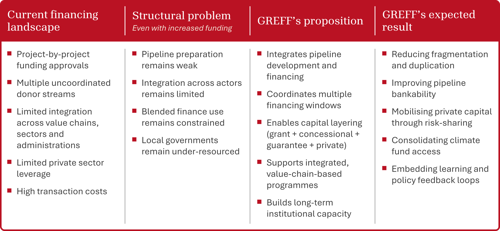
Although more funding is available for climate-related investments, challenges in preparing projects and the high cost of transactions can make it difficult for funding to reach projects effectively. GREFF aims to address these challenges by helping develop a stronger pipeline of projects, coordinating different sources of financing, and encouraging private investment in key sectors. Depending on the investment needs, the Facility could combine grants, loans on favourable terms, guarantees and private finance. Guarantees would help share financial risks, potentially making investments more attractive to private investors. 

How GREFF is intended to improve access to climate finance 


"At NIRAS, we believe that achieving Nepal's climate and development ambitions requires moving beyond standalone projects towards coordinated, evidence-based, and finance-ready investment programmemes. Through the GREFF design TA, we are proud to support ADB and the Government of Nepal in translating robust analysis into scalable investment opportunities aligned with national priorities and capable of delivering lasting benefits for communities across the country," says Swechya Mathema, Project Manager for GREFF. 

Through its technical assistance, NIRAS is helping establish the structure, processes and supporting documents needed for the GREFF to operate. This provides the Government of Nepal with a framework for directing financing towards investments that can strengthen climate resilience in the country. Whether GREFF attracts additional investment and strengthens resilience will need to be assessed once financing and implementation begin. 

For more information on GREFF, contact:

Swechya Mathema

Swechya Mathema

Business Development Manager

Kathmandu, Nepal